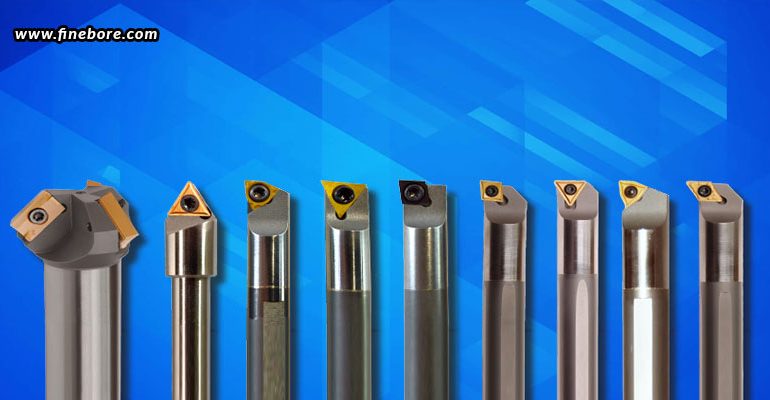
In machining, productivity and precision are often linked to the machine tool or the boring bar itself. However, the true performance of a boring bar is largely influenced by the insert it carries. As the actual cutting interface, the insert directly impacts cutting forces, vibration, and stability – key factors that define how effectively a boring bar performs. And, in boring operations, where rigidity is already limited, the right insert can enhance the bar’s performance, while the wrong choice can restrict its potential. This blog explores how inserts unlock the full capability of boring bars, and how they play a key role in achieving consistent and efficient machining results.
Why inserts matter more for boring bars
Boring bars operate under inherently challenging conditions. Due to their extended reach inside the workpiece, they behave like cantilevered tools, making them more prone to deflection and vibration. This means that every cutting force generated at the insert level directly affects the stability of the boring bar. Unlike external turning, where rigidity is higher, boring bar performance is highly sensitive to how the insert engages with the material. A well-matched insert reduces cutting resistance acting on the boring bar, improving stability and control. On the other hand, a wrong choice can increase stress on the bar, leading to chatter, poor surface finish, and reduced accuracy. Hence, inserts do not just cut the material; they directly influence how efficiently a boring bar performs.
Selecting the right insert
Inserts are available in a wide range of grades, coatings, and geometries to suit different materials and machining conditions.
- Insert grade for boring bar stability
Insert grade refers to the material composition and properties of the cutting insert, such as hardness, toughness, and wear resistance. It determines how well the insert performs under specific machining conditions and materials. It plays a foundational role in determining how well a boring bar will be able to handle cutting forces and vibration. For instance, hard insert grades offer excellent wear resistance, but can be brittle under unstable conditions. On the other hand, tough insert grades are better suited for boring bars as they can absorb fluctuating forces and resist chipping. Selecting the correct insert grade based on the workpiece material ensures that the cutting forces remain controlled. for instance, steel requires balanced grades, while stainless steel benefits from tougher grades due to work hardening. In contrast, cast iron performs better with harder, wear-resistant grades. A properly selected grade reduces stress on the boring bar, enabling smoother and more stable machining.
- Coating for managing heat and friction in boring bars
Insert coatings play a crucial role in enhancing boring bar performance by controlling heat and friction at the cutting interface. Efficient coatings reduce friction, which directly improves stability, especially in long overhang conditions. They also provide thermal resistance, which is essential in internal machining where heat tends to accumulate. PVD coatings offer sharper edges and are ideal for finishing operations, while CVD coatings are great for durability in the case of higher cutting loads. In boring bars, where excessive heat can affect dimensional accuracy and rigidity, the right coating maintains consistent performance and prolongs tool life.
- Insert geometry for controlling cutting forces and vibration
The shape and design of an insert also play a crucial role in determining how a boring bar performs during machining. When the cutting edge is angled forward (positive rake geometry), it becomes sharper and easier to cut, which reduces cutting forces, minimizes vibration, improves stability, and brings a smoother boring process. On the contrary, when the cutting edge is angled backward (negative rake geometry), it becomes stronger and more durable, making it capable of handling higher loads. But, this also increases cutting forces, vibration, and resistance, which can all destabilize the bar in less rigid setups. This is why, for most boring applications, positive geometry is preferred as it allows for smoother cutting with less stress on the tool.
The relationship between inserts and cutting parameters
The effectiveness of an insert is closely tied to how well it is matched with cutting parameters. For instance,
- The cutting speed must align with the insert’s grade and coating to avoid excessive heat or inefficient cutting
- The feed rate should ensure proper chip formation without overloading the boring bar
- The depth of cut must be balanced to prevent excessive force that can cause deflection
When these parameters and the inserts and parameters are properly aligned, cutting forces remain controlled, allowing the boring bar to operate within its optimal performance range.
What happens when the right selection is not made?
Improper insert selection or usage can significantly affect boring bar potential. When the selection of the insert grade or coating is wrong, it can result in rapid wear and premature tool failure, increasing downtime and reducing efficiency. The incorrect geometry, such as choosing negative rake geometry, can amplify vibration in the boring bar. Such unsuitable choices or using worn inserts can lead to inconsistent cutting, affecting surface finish and dimensional accuracy. In many cases, this also increases cutting forces, putting additional stress on the boring bar and reducing overall stability. Proper insert selection is thus important to maintain consistent boring bar performance. It also helps ensure predictable machining outcomes and better overall process control.
Practical tips for maximizing boring bar performance through inserts
There are some small practices that can be implemented to fully utilize boring bar potential, ensuring that the tool consistently operates at its best.
- Select inserts based on application and material to ensure compatibility, controlled cutting forces, and consistent performance.
- Choose positive geometry for better stability, as it reduces cutting resistance and minimizes vibration in boring bar operations.
- Ensure proper insert seating and alignment to avoid uneven cutting, vibration issues, and potential damage to the boring bar.
- Monitor wear patterns regularly to identify early signs of failure and maintain consistent machining quality and tool performance.
- Replace inserts before performance drops to prevent poor surface finish, increased cutting forces, and unexpected machining interruptions.
In boring operations, inserts do more than just remove material; they define how effectively a boring bar performs. From controlling cutting forces to managing heat and vibration, every aspect of insert selection directly influences stability and output. By choosing the right insert grade, coating, and geometry, manufacturers can significantly reduce vibration, improve surface finish, and extend tool life. More importantly, they can unlock the full potential of their boring bars, achieving higher efficiency and consistent machining results. Understanding the role of inserts is a strategic approach to maximizing boring bar performance. For manufacturers looking to enhance machining performance with reliable tooling, companies like FineTech Toolings, known for quality boring bars tools, play a crucial role in supporting consistent and efficient boring operations.