The-Hidden-Role-Of-Inserts-In-Unlocking-Boring-Bar-Potential

The Hidden Role Of Inserts In Unlocking Boring Bar Potential

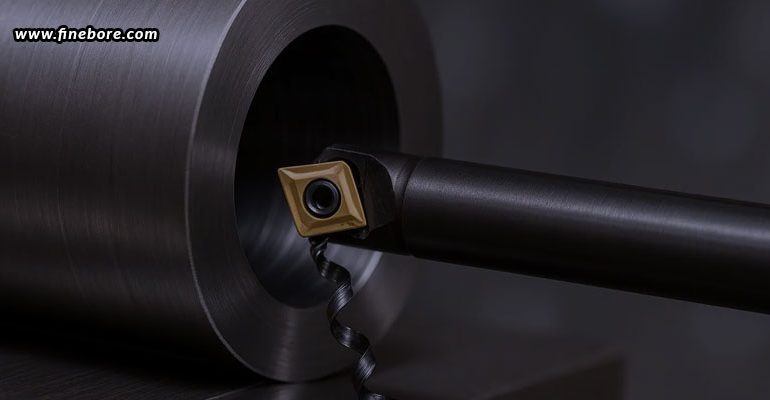
In machining, productivity and precision are often linked to the machine tool or the boring bar itself. However, the true performance of a boring bar is largely influenced by the insert it carries. As the actual cutting interface, the insert directly impacts cutting forces, vibration, and stability

Read More
Small-Adjustments-That-Can-Boost-Boring-Bar-Output

Small Adjustments That Can Boost Boring Bar Output

In contemporary machining settings, productivity is frequently associated with advanced tooling systems, high-performance CNC machines, or automation. Nevertheless, some of the most significant enhancements come from simple, minor, and well-informed modifications. In boring operations, where stability, precision, and consistency are of utmost importance, simple micro-adjustments in setup

Read More
Understanding-Boring-Bar-Overhang-How-Much-Is-Too-Much

Understanding Boring Bar Overhang – How Much Is Too Much?

In precision machining, tool settings determine the final result. Among the many variables that affect machining performance, boring bar overhang is one of the most important. Whether boring deep holes in hardened steel or finishing tight tolerance hydraulic components, the length of the boring bar has a

Read More
The-Balance-Between-Rigidity-And-Flexibility-In-Boring-Head-Design

The Balance Between Rigidity And Flexibility In Boring Head Design

In precision boring, rigidity is frequently viewed as the key determinant of performance; however, this viewpoint is not entirely accurate. Although structural stiffness is crucial for preserving dimensional stability, an overabundance of rigidity, lacking the capacity to absorb cutting forces, can lead to vibrations that compromise surface

Read More
Why-Deep-Hole-Boring-Is-One-Of-The-Most-Challenging-Machining-Operations

Why Deep Hole Boring Is One Of The Most Challenging Machining Operations

In contemporary manufacturing, achieving accurate internal dimensions is essential for the production of high-performance components. Industries like automotive, aerospace, heavy machinery, oil and gas, and energy depend on internal machining to fabricate cylinders, housings, and structural elements. Among these techniques, deep hole boring presents significant challenges. As

Read More
Challenges-Of-Boring-Bars-In-Aerospace-Machining

Challenges Of Boring Bars In Aerospace Machining

Modern aerospace manufacturing represents one of the most challenging settings for precision machining. Components for aircraft and spacecraft are required to adhere to extremely stringent tolerances, endure severe operating conditions, and preserve structural integrity throughout extended service durations. Numerous essential parts depend on accurately machined internal bores

Read More
Maximizing-Boring-Bar-Performance-Through-Proper-Tool-Holder-Selection

Maximizing Boring Bar Performance Through Proper Tool Holder Selection

Boring operations are essential in precision machining, especially for achieving accurate internal diameters and smooth surface finishes. While machinists typically concentrate on selecting the appropriate boring bar, the significance of the tool holder should not be overlooked. Serving as the link between the machine and the cutting

Read More
Fine-Tuning-Boring-Bars-For-Better-Surface-Finish

Fine-Tuning Boring Bars For Better Surface Finish

In precision machining, a high-quality surface finish is not just a matter of appearance; it has a direct impact on the performance of components, including factors like friction, wear resistance, and the fit during assembly. A polished surface finish can significantly enhance the functionality of mechanical systems,

Read More
The-Science-Of-Surface-Finish-In-Boring-Applications

The Science Of Surface Finish In Boring Applications

Surface finish in boring processes is not merely a visual or aesthetic concern; it is a vital element that significantly affects component performance, fatigue strength, sealing ability, friction, wear resistance, and dimensional precision. In high-precision sectors such as aerospace, automotive, hydraulics, energy, and medical manufacturing, the quality

Read More