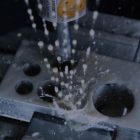
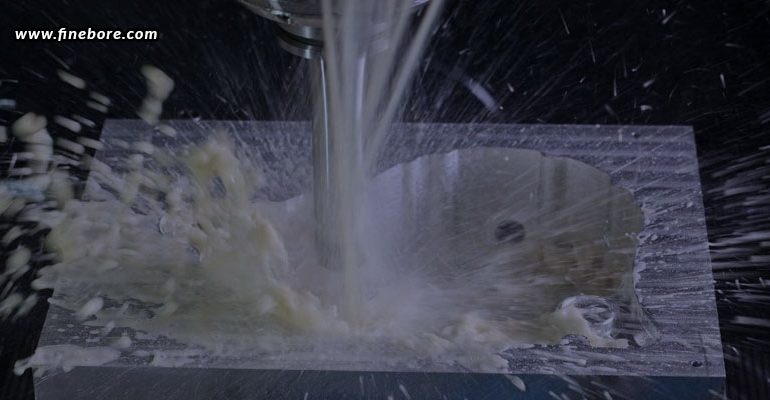
Internal machining operations require exceptional precision, particularly when dealing with deep bores, difficult materials, and stringent tolerances. In boring applications, the delivery of coolant is crucial, extending beyond mere temperature regulation. It has a direct impact on chip removal, surface quality, tool longevity, dimensional precision, process reliability, and overall efficiency. Manufacturers typically implement two coolant strategies during boring operations – through-tool cooling and external cooling. Each presenting unique benefits based on factors like material type, bore depth, and machining conditions. This blog compares both cooling methods across materials like titanium, steel, and composites to highlight how effective coolant management enhances boring performance and machining uniformity.
Why the coolant matters
Unlike external turning, boring operations occur within confined spaces, making it challenging to manage heat, chips, and cutting forces. As the boring bar penetrates deeper into the workpiece, various issues arise. Heat builds ups near the cutting edge, chips find it hard to escape, the coolant struggles to reach the cutting zone, vibration and chatter levels rise, and the surface finish worsens. to manage such situations and maintain stable machining conditions, effective coolant delivery becomes essential. Coolants are responsible for cooling the cutting zone, lubricating the interface between the tool and workpiece, and removing chips from the bore.
Understanding external cooling
External cooling is where the coolant is directed toward the boring bar from outside the bore; the fluid is sprayed onto the cutting zone from nozzles positioned outside the tool. This method is simple, easy to maintain, and cost-effective, also compatible with most standard machines.
Advantages of external cooling
- Low initial cost: External coolant systems are less expensive to install as many lathes and machining centres already support flood coolant setups.
- Easy maintenance: Because there are no internal coolant channels inside the tool, maintenance is easy and there are low clogging risks.
- Effective for short bores: External coolants are adequate for shallow internal turning operations as the cutting edge remains accessible.
Limitations of external cooling
- Poor coolant penetration: Deep bores restrict coolant flow, making it difficult for coolant to consistently reach the cutting edge effectively.
- Inadequate chip evacuation: External coolant often cannot remove trapped chips, leading to recutting, scratches, and insert and tool damage.
- Reduced tool life: Insufficient cooling at the cutting edge leads to excessive heat buildup, especially in difficult materials.
- Inconsistent surface finish: When chips remain trapped inside the bore, they interfere with the cutting process and damage surface quality.
Understanding through-tool cooling
Through-tool cooling delivers coolant through internal channels inside the boring bar directly to the cutting edge. Unlike external cooling, coolant exits near the insert, improving chip evacuation, controlling cutting temperatures more effectively, and enhancing surface finish quality by supplying coolant precisely where it is most needed during machining operations.
Advantages of through-tool cooling
- Superior chip evacuation: High-pressure coolant efficiently removes chips from the bore, preventing recutting, insert damage, and chip entanglement around the tool.
- Better heat control: Direct coolant delivery reduces cutting temperatures, minimizing thermal expansion, insert wear, and dimensional inconsistencies during machining operations.
- Improved surface finish: Consistent chip removal and lower vibration levels help produce smoother, more accurate, and higher-quality internal bore surfaces.
- Increased tool life: Stable cutting conditions and effective cooling significantly reduce insert wear, extending overall tool life and machining reliability.
- Higher productivity: Improved process stability enables higher cutting speeds, greater feed rates, and longer uninterrupted machining cycles with consistent performance.
Limitations of through-tool cooling
- Higher cost: Through-tool systems require specialized tooling, coolant pumps, holders, and machine configurations, resulting in higher overall setup investment.
- Maintenance requirements: Coolant passages may clog without proper filtration, making regular maintenance and effective coolant filtration essential for reliable performance.
- Machine compatibility: Older machining systems may lack the capability to support high-pressure through-tool coolant delivery and advanced coolant configurations.
Comparing performance by material
The effectiveness of coolant strategies changes dramatically depending on the workpiece material.
- Titanium
Titanium generates high cutting temperatures and difficult chips, making internal machining highly demanding. In deep boring operations, through-tool cooling performs better by delivering coolant directly near the insert, improving heat dissipation and chip evacuation. This reduces insert wear, improves machining stability, and helps maintain dimensional accuracy and surface quality in precision titanium components.
- Steel
Steel machining supports both external and through-tool cooling systems depending on bore depth and application complexity. While external coolant works well for shallow operations, through-tool cooling becomes more effective in deeper bores by improving chip evacuation, reducing chatter, and maintaining stable cutting conditions. This results in better surface finish, longer tool life, and improved machining consistency.
- Composites
Composite materials require controlled cooling because they are sensitive to heat and surface damage. External air cooling or mist systems are commonly preferred to prevent delamination and fibre pullout. Through-tool cooling may still be used for specialized hybrid components, but coolant pressure and flow must be carefully regulated to maintain surface quality and prevent material deterioration.
Common coolant mistakes in boring operations
Effective coolant management is essential in boring operations, as improper coolant application can negatively affect tool life and machining stability.
- Using external coolant for deep bores: Standard flood coolant often cannot reach deep cutting zones where direct internal coolant delivery becomes necessary.
- Poor filtration: Contaminated coolant and blocked passages reduce cooling efficiency, increase insert wear, and negatively affect overall tooling performance and reliability.
- Insufficient coolant pressure: Low coolant pressure limits effective chip evacuation, increasing the risk of recutting, vibration, and unstable machining conditions.
- Incorrect coolant direction: Improper nozzle positioning prevents coolant from reaching the cutting edge effectively, reducing cooling and chip removal performance.
- Ignoring material behaviour: Different materials require specific coolant strategies to maintain temperature control, chip evacuation, and machining consistency.
Coolants are no longer secondary elements; they are a critical performance factor. While external cooling is still effective for many standard applications, through-tool cooling has gained significance for deep-hole boring, tight tolerances, and high-production settings. The type of material also significantly influences the cooling approach. Titanium benefits most from through-tool cooling, steel supports both systems depending on application complexity, while composites require controlled cooling strategies. As the demands for internal machining continue to escalate in terms of precision and complexity, coolant delivery systems will remain essential for enhancing tool life, productivity, and machining reliability. Advanced boring bar systems with optimized coolant delivery and stable tool performance play a major role in achieving consistent internal machining results. Companies like FineTech Toolings provide precision boring bars tools designed to support efficient chip evacuation, improved machining stability, and high-performance boring operations.