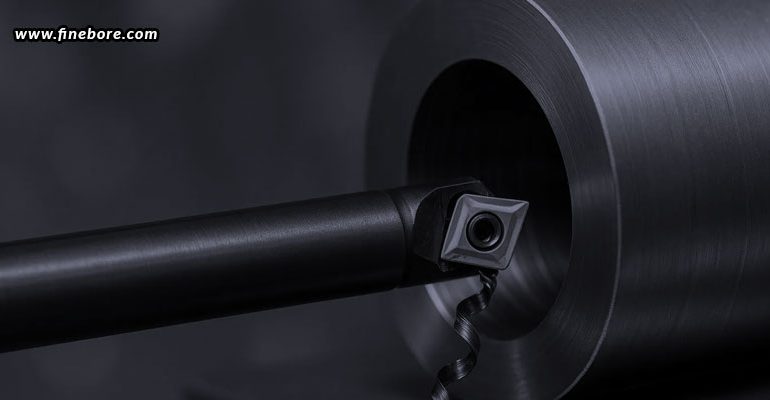
In contemporary manufacturing, achieving accurate internal dimensions is essential for the production of high-performance components. Industries like automotive, aerospace, heavy machinery, oil and gas, and energy depend on internal machining to fabricate cylinders, housings, and structural elements. Among these techniques, deep hole boring presents significant challenges. As the depth of the hole increases in relation to its diameter, it becomes increasingly difficult to maintain tool stability, efficiently remove chips, and manage heat. Machinists must meticulously control vibration, chip removal, coolant application, and tool rigidity throughout the operation. If any of these aspects are inadequately managed, it can result in inaccurate dimensions, subpar surface finishes, accelerated tool wear, and reduced overall machining reliability.
The critical challenge of tool rigidity
One of the primary challenges in deep hole boring is ensuring tool rigidity. When machining shallow holes, the boring tool is adequately supported by the machine spindle. However, as the hole’s depth increases, the tool must extend further from the spindle, resulting in a long overhang. This increased reach significantly reduces the tool’s stiffness. A long and slender boring bar is prone to bending slightly under cutting forces, which can lead to various issues like tapered holes, oversized diameters, poor roundness, and inconsistent surface finish. Even slight deflection can result in significant inaccuracies when machining high-precision components. To mitigate these problems, manufacturers frequently utilize:
- Carbide boring bars, which offer greater stiffness compared to steel bars
- Anti-vibration boring bars, engineered with internal damping systems
- Optimized tool diameters, where the largest feasible bar diameter is employed for enhanced rigidity
The goal is to establish a tooling arrangement that remains stable throughout the cutting operation, even at extended lengths.
The challenge of vibration control
Vibration poses one of the greatest challenges in deep hole boring. When the boring tool vibrates during the machining process, the cutting edge strikes the workpiece surface repeatedly instead of cutting smoothly. This leads to various problems, such as poor surface finish, reduced dimensional accuracy, increased tool wear, loud noise, and unstable machining conditions. In deep hole operations, the likelihood of vibration increases because the tool acts like a long cantilever beam, which is inherently susceptible to oscillation under cutting forces. Machinists usually tackle vibration by modifying several machining parameters and tooling strategies, including:
- Optimizing the overhang ratio
- Using damped boring bars
- Modifying cutting parameters
The goal is to establish a tooling setup that remains stable throughout the cutting process, even at extended lengths.
The challenge of chip evacuation
Chip evacuation presents a considerable challenge in deep hole boring. As machining progresses, metal chips are continuously produced as the cutting edge removes material from the workpiece. In shallow holes, these chips can easily escape. However, in deep holes, they must travel a significantly longer distance to exit the cutting zone. If chips build up within the hole, various issues may arise, such as chip blockage, tool damage, scratches on the machined surface, increased cutting forces, and unexpected tool breakage. In severe situations, chips can become lodged between the tool and the workpiece, potentially ruining the surface finish or harming the cutting insert. To facilitate effective chip removal, machinists frequently adopt strategies such as:
- Utilizing chip-breaker insert designs
- Modifying feed rates to create manageable chip shapes
- Implementing high-pressure coolant systems
- Choosing suitable cutting parameters for chip management
Effective chip evacuation is crucial for sustaining consistent machining conditions during deep hole operations.
The challenge of ensuring dimensional precision over long distances
Another significant challenge in deep hole boring is ensuring uniform dimensional precision throughout the full length of the hole. When machining deep internal features, even minor fluctuations in cutting forces, tool deflection, or machine stability can lead to dimensional discrepancies. These discrepancies may manifest as tapered holes and irregular surface finishes. Achieving tight tolerances necessitates meticulous attention to various factors, including:
- Machine tool rigidity
- Toolholder stability
- Accurate spindle alignment
- Appropriate selection of cutting parameters
Modern CNC machines enhance consistency by providing precise control over spindle speed, feed rate, and tool positioning. Nevertheless, even state-of-the-art machines depend significantly on proper tooling and setup to deliver dependable outcomes in deep hole operations.
Challenges of surface finish in deep holes
Achieving a superior surface finish within deep holes can prove to be quite challenging. Factors influencing surface roughness include tool vibration, chip recutting, insert wear, and inadequate coolant delivery. In many industries, internal surfaces must adhere to stringent specifications to guarantee optimal performance. For instance, hydraulic cylinders necessitate smooth internal surfaces to minimize friction and avert seal damage. To enhance surface finish, machinists might:
- Utilize fine boring tools for finishing operations
- Implement optimized cutting parameters
- Ensure effective chip removal
- Employ high-quality cutting inserts specifically designed for internal machining
These strategies contribute to achieving smooth and uniform surfaces, even in deep internal features.
Machine tool limitations
Deep hole boring imposes significant requirements on the machine tool itself. Machines are required to offer:
- High spindle stability
- Precise tool alignment
- Robust structural rigidity
- Efficient coolant delivery systems
Aging or less rigid machines may find it challenging to sustain stable cutting conditions during deep internal machining tasks. Many manufacturers thus depend on contemporary CNC machining centres that are specifically engineered for precision boring tasks. The capability of the machine is crucial in assessing whether deep hole boring can be executed effectively and accurately.
Advanced tooling solutions for deep hole machining
To address the challenges associated with deep hole boring, tooling manufacturers have created specialized solutions tailored specifically for internal machining. Some of the key advancements include:
- Anti-vibration boring bars: These tools incorporate internal damping systems that mitigate vibration and stabilize the cutting process.
- Carbide tool bodies: Carbide bars offer increased stiffness in comparison to steel bars, making them suitable for applications with long overhangs.
- Internal coolant channels: Contemporary boring tools frequently include internal coolant channels that supply coolant directly to the cutting edge.
- Optimized insert geometries: Sophisticated insert designs enhance chip control, lower cutting forces, and improve surface finish.
With these innovations, manufacturers can perform deep hole boring operations with greater reliability and precision. Companies like FineTech Toolings, known for their precision boring tools in Bangalore, provide high-quality tooling solutions engineered to meet the demanding requirements of precision machining and deep internal boring applications.
Deep hole boring represents one of the most challenging tasks in precision machining. The extended reach of tools, limited space for chip evacuation, and restricted access to coolant create a difficult environment for both tools and machines. Machinists need to meticulously manage tool rigidity, control vibrations, ensure effective chip removal, and deliver coolant efficiently to sustain stable cutting conditions and achieve precise results. Even minor changes in setup or machining parameters can impact the quality of the hole. While advancements in tooling technology and machining strategies have enhanced reliability, deep hole boring still demands significant expertise, thorough planning, and meticulous attention to detail to uphold precision, productivity, and consistent machining performance.