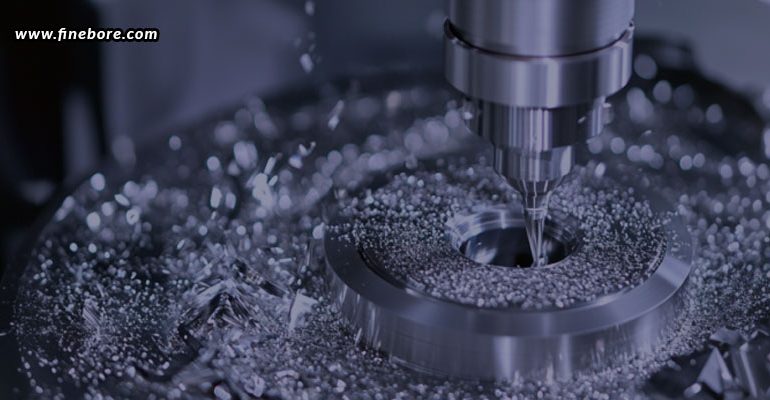
In precision machining, bore quality depends on more than the cutting insert or machine capability. The geometry of the boring head plays a direct role in how the cutting edge engages with the workpiece, generates cutting forces, and responds to changing machining conditions. Every element, from the head’s cutting geometry and insert position to its mass distribution and rigidity, can influence how smoothly material is removed. When these factors are properly coordinated, the boring head can maintain a controlled cutting action with reduced vibration and predictable tool behaviour. Understanding this relationship is essential for achieving dimensional accuracy, consistent surface finish, and reliable performance across different boring applications.
How boring head geometry controls cutting forces
Boring head geometry determines how the cutting edge enters, penetrates, and removes material from the bore. Rake angle, clearance angle, cutting-edge orientation, insert position, and nose geometry all influence the direction and magnitude of forces generated during cutting. A geometry that promotes efficient shearing can reduce unnecessary resistance, allowing material to be removed with less cutting effort. The position of the cutting edge also affects the balance between radial and axial forces. Excessive radial force can push the tool away from the intended cutting path, particularly when boring long or relatively flexible components. Similarly, an unsuitable approach angle can increase the load placed on the cutting edge and tool assembly. Therefore, boring head geometry is not simply about enabling the insert to cut. It determines how cutting energy is transferred through the tool. Controlling these forces at the cutting edge establishes the conditions required for stable machining and predictable dimensional performance.
From cutting forces to machining stability
The forces generated by the cutting edge travel through the insert, tool holder, boring head, and machine spindle before being absorbed by the complete machining system. If the boring head is sufficiently rigid and its geometry distributes these forces effectively, the cutting process remains controlled. When the forces become excessive or poorly balanced, however, the system can begin to deflect or vibrate. This is where cutting geometry and structural design become closely connected. Even an efficient cutting edge can produce unstable results if the boring head lacks adequate rigidity for the application. Conversely, a highly rigid head may not deliver its full potential if its cutting geometry creates unnecessarily high radial or tangential forces. Machining stability therefore depends on how effectively the boring head manages the forces created during cutting. Proper geometry helps minimise disruptive forces, while sufficient stiffness and balanced construction help resist their effects. Together, they create a more predictable cutting process with reduced tendency toward chatter, deflection, and inconsistent tool movement.
How geometry and stability together affect bore quality
Bore quality is the visible result of how effectively the boring head manages cutting forces and maintains stability throughout machining. When the cutting geometry produces controlled forces and the tool structure resists deflection, the cutting edge can follow its intended path more consistently. This supports accurate bore dimensions and helps maintain the required geometry along the machined surface. Stability is particularly important because even small vibrations or movements can leave repeating marks, affect surface finish, or cause variations in bore diameter. Deflection can also shift the cutting edge away from its programmed position, resulting in dimensional errors. The interaction between geometry and stability therefore has a direct effect on surface finish, roundness, straightness, and dimensional consistency. A well-designed boring head does not treat cutting efficiency and stability as separate objectives. Instead, its geometry is developed to create favourable cutting conditions while its structural characteristics provide the support necessary to maintain those conditions throughout the machining operation.
Designing boring heads for different cutting conditions
Boring heads must be designed around the conditions in which they will operate because cutting requirements can vary considerably between applications. Material characteristics, bore diameter, machining depth, cutting speed, feed rate, and material removal requirements all influence the forces acting on the tool. For heavy material removal, the boring head needs adequate rigidity and a cutting geometry capable of handling higher loads without excessive deflection. Finishing operations, on the other hand, may place greater emphasis on controlled cutting action, dimensional accuracy, and surface finish. Deep bores can introduce additional challenges because increased tool overhang can reduce stiffness and make vibration more likely. The selected geometry must therefore complement the intended cutting conditions. Insert configuration, cutting-edge geometry, head dimensions, and overall structural strength should work together rather than being considered independently. Designing the boring head around the actual machining environment allows cutting forces to remain manageable while maintaining the stability required for consistent results.
What to consider when selecting a boring head
Selecting the right boring head requires looking beyond the required bore size. The tool must suit the machining conditions, machine-tool system, and desired level of accuracy and stability. Key factors include:
- Bore diameter and depth: Choose a boring head that accommodates the required bore dimensions while providing sufficient reach for the machining depth.
- Workpiece material: The material being machined influences cutting forces, tool loading, and the geometry required for efficient material removal.
- Rigidity: Adequate structural rigidity is essential for deep bores, difficult materials, and tight-tolerance applications where deflection and vibration can affect accuracy.
- Cutting geometry: Rake angle, clearance angle, insert orientation, and cutting-edge configuration should match the intended operation, whether roughing, finishing, or balanced machining.
- Insert compatibility: Ensure that the boring head supports suitable inserts and allows the required cutting configuration for the application.
- Adjustment capability: Precise adjustment is important when the machining operation demands accurate control over bore dimensions.
- Tool overhang: Excessive overhang can reduce stiffness and increase the risk of vibration, making the relationship between tool reach and rigidity an important consideration.
- Spindle interface: The boring head should be compatible with the machine’s spindle and tooling system to ensure secure and accurate mounting.
- Overall balance: Proper balance becomes increasingly important at higher spindle speeds, helping support smoother operation and consistent cutting performance.
- Application requirements: Consider the complete machining system, including cutting parameters, productivity targets, dimensional tolerances, surface-finish requirements, and machine capabilities, rather than selecting a boring head based solely on bore size.
For manufacturers looking for boring head manufacturers, evaluating engineering expertise, product precision, application suitability, and manufacturing consistency is essential when selecting a tooling partner. FineTech Toolings is positioned as one of the top boring head manufacturers in India, offering boring solutions developed around the requirements of modern machining applications.
Boring head geometry has a direct influence on how cutting forces are generated, transferred, and controlled during machining. These forces, in turn, determine how effectively the tool can maintain stability against deflection and vibration. When cutting geometry and structural design work together, the boring head can maintain a more consistent cutting path and support accurate, high-quality bores. This makes geometry an important consideration not only for cutting efficiency but also for dimensional control and surface performance. Choosing the right boring head therefore requires looking beyond basic tool compatibility and considering how its geometry, rigidity, balance, and configuration will perform under the specific cutting conditions of the application.