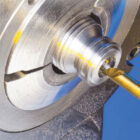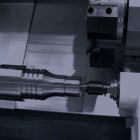
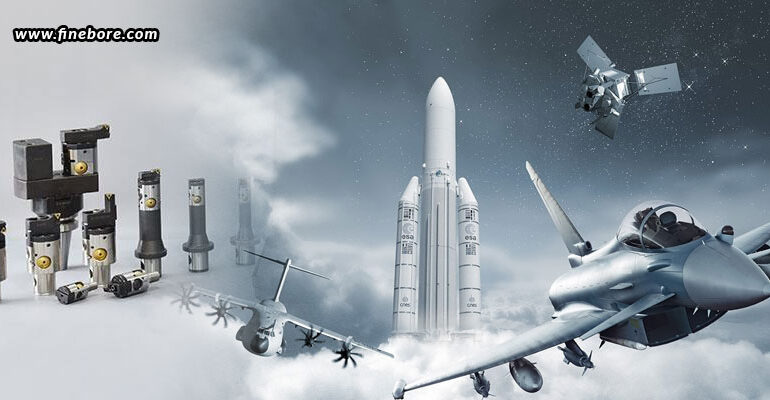
In the industries of defence and aerospace manufacturing, precision is not just a preference, it is a necessity. Components that are critical to flight require extremely tight tolerances, perfect surfaces, and unwavering reliability. Boring heads are essential in the machining of parts like landing gear, hydraulic housings, turbine casings, and navigation pins. This blog delves into how specialized boring heads, techniques, and quality assurance systems fulfil these stringent high-tolerance demands in mission-critical industries.
The importance of precision boring in aerospace and defence
Parts used in aerospace and defence are subjected to severe physical and regulatory limitations. Even the slightest flaw can result in disastrous failures. This is why the industry requires bore finishes that are devoid of micro-burrs, with exact shoulders, tapers, and blend radii, alongside rigorous traceability and certification processes. Boring heads must produce flawless surfaces and uphold tolerances that are tighter than standard industry specifications, often within microns. The materials involved, such as aluminium alloys, titanium, nickel superalloys, and composites, present significant machining challenges. These alloys necessitate robust tooling that can achieve clean cuts and precise finishes under demanding thermal and vibrational conditions.
Specialized boring heads and tooling innovations
Aerospace and defence components demand the highest levels of precision. Specialized boring heads and cutting-edge tooling are engineered to withstand extreme stresses, deliver tight tolerances, and support the machining of exotic alloys used in mission-critical parts.
- Sturdy tooling with edge precision
Aerospace and defence tooling must ensure rigidity across all modular connections and extend to the cutting edge. Elements such as insert holders and clamping screws need to withstand bending, even when machining intricate taper angles or large blend radii up to 31 mils. Tool assemblies should prevent any “float” to facilitate chatter-free cutting.
- Optimized edge geometry and inserts
Boring heads designed for aerospace applications frequently utilize inserts with specific lead angles and unique geometries to create optimal shoulders, and blend radii that are crucial for stress distribution in structural components. Ceramic-tipped and carbide inserts are prevalent due to their durability and capability to machine exotic alloys.
- Coolant-through and vibration mitigation
Due to the requirement for micro-level precision, coolant-through heads and vibration-damped boring bars are vital. They handle heat generation, chip removal, and vibrations that could otherwise jeopardize surface quality and tolerances.
- Digital or smart boring heads
These advanced heads enable real-time micron adjustments and monitoring of cutting forces, enhancing control during finishing cuts. They allow for incremental adjustments for tolerances below a thousandth of an inch without the need to remove the tool from the machine.
Methods to guarantee accuracy and surface integrity
Achieving impeccable surface finishes and micron-level tolerances in aerospace applications requires more than just precision tooling; it calls for a refined approach to finishing, chatter control, and real-time inspection throughout the boring process.
- Step and interpolated finishing
Significant roughing operations should be succeeded by lighter finishing passes that utilize fine feed control. Studies indicate that this method enhances the mirror-like surface finish and complies with stringent aerospace standards.
- Controlled entry/exit and chatter prevention
Smooth arc-based entry and exit techniques help avoid surface smearing. When paired with robust tool systems, they provide burr-free and blemish-free finishes that are crucial for flight-critical components.
- In-process inspection
Regular application of in-situ metrology during boring operations allows for the prompt identification of deviations, which lowers scrap rates and speeds up first-article approval.
Best practices for tooling strategy
To meet the rigorous standards of the defence and aerospace industries, manufacturers must implement proven tooling strategies that maximize rigidity, thermal stability, and traceability – ensuring consistency, safety, and audit-ready performance in every machined part.
- Opt for rigid, insert-compatible boring heads to ensure there is no structural flex at the cutting edge.
- Choose inserts designed with aerospace-grade geometry – lead-angle shoulders, micro-burr-free cutting, and compatibility with high-temperature alloys.
- Utilize damping and coolant-through systems to control heat and eliminate vibrations.
- Employ digital adjustment tools for precise tuning without the need for tool changes.
- Monitor witness marks and ensure complete traceability for part certification and auditing purposes.
Quality & regulatory standards
Manufacturing in aerospace and defence industries adheres to rigorous quality control and documentation standards: ITAR compliance, AS9100D certification, traceability records, and inspection protocols. Components frequently necessitate first-article inspection or 100%-dimensional verification prior to release; for instance, all critical bores or plating features. Bore tolerances in defence components can achieve ID flatness of .00001″ (.254 µm) and ODI tolerances as tight as .000006″ (.152 µm), with surface finishes as smooth as 0.4 Ra.
The role of leading manufacturers in India
Manufacturers specializing in aerospace-grade boring heads meet the required stringent requirements. Top providers supply modular, robust boring systems, cutting-edge inserts for exotic alloys, and digital control features that comply with strict aerospace tolerances. As India’s defence and aerospace manufacturing industries expands, tooling companies are making strides with solutions that adhere to international quality standards and emphasize consistency in high-speed or high-precision machining. Among the trusted boring head manufacturers in India, Finetech Toolings stands out for delivering precision-engineered solutions tailored to aerospace applications. Their commitment to innovation, reliability, and performance makes them a preferred partner in critical machining environments.
Precision boring in the aerospace and defence industries is propelled by the necessity for exceptional accuracy, traceability, and dependability. Every aspect – from advanced boring head components and insert geometries to real-time adjustments and stringent inspection protocols – contributes to achieving impeccable results. With the increasing manufacturing demands in India, collaborating with proficient tooling suppliers that provide aerospace-grade boring head technology is crucial for producing mission-critical components. Boring heads effectively connect raw materials to high-tolerance performance in aerospace and defence manufacturing.