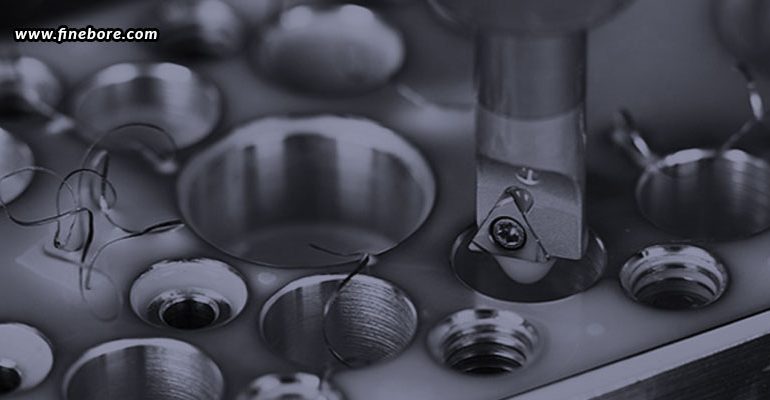
The wrong boring bar can affect almost every aspect of an internal machining operation. Bore accuracy, surface finish, tool life, machining stability, and productivity can all be affected when the boring bar does not match the actual requirements of the application. Effective boring bar selection involves several interconnected factors such as tool rigidity, overhang, bore depth, workpiece material, insert compatibility, cutting conditions, machine capability, and production requirements. Any wrong choice can generate problems like chatter, tool wear, rework, increased costs, and much more. Understanding these mistakes allows manufacturers to make more informed tooling decisions and establish more consistent machining processes.
Mistake 1: Choosing a boring bar that is too small
Selecting a boring bar with a smaller diameter than necessary sacrifices rigidity, because a smaller cross-section is more susceptible to bending when exposed to cutting forces. This can lead to tool deflection, dimensional variation, chatter, poor surface finish, and reduced tool life. An appropriately sized boring bar will provide the required rigidity and stiffness that can help maintain stability. However, the goal is not to select the largest tool regardless of the application, but to find the largest diameter that provides adequate clearance for safe machining and chip evacuation.
Mistake 2: Using excessive tool overhang
Excessive overhang is another major cause of instability because the longer the unsupported section becomes, the more susceptible the tool is to bending and vibration. Unnecessary overhang can result in deflection, poor dimensional control, chatter, reduced surface quality, and premature insert wear. A boring bar should extend only as far as required to reach the machining depth. For applications where long reach is unavoidable, a carbide or damped boring bar should be considered to provide greater stiffness or vibration control.
Mistake 3: Ignoring bore depth
A tool that works effectively for a shallow bore may not perform equally well in a deep bore. Increasing machining depth usually requires greater tool extension, which can reduce rigidity. Deep boring applications may therefore require specialized boring bar designs with increased rigidity, vibration control, appropriate insert geometry, and carefully controlled cutting conditions. Selecting a boring bar without considering the required machining depth can result in instability and inconsistent bore quality.
Mistake 4: Not considering the type of boring operation
Different boring operations place different demands on the tool. Rough boring focuses heavily on material removal and tool strength, while finish boring places greater emphasis on dimensional accuracy and surface quality. Blind holes, deep bores, interrupted cuts, and precision bores can each require different tooling characteristics. The tool should thus be matched to the actual operation rather than selected based solely on bore diameter or material type.
Mistake 5: Choosing the boring bar without considering the insert
Pairing the boring bar with an unsuitable insert can compromise machining performance. Key insert considerations include insert shape, grade, cutting-edge geometry, nose radius, chip breaker, and coating. The insert should match the workpiece material and intended operation, while its geometry should support the required cutting conditions. Choosing the right insert helps maintain cutting stability, control chip formation, improve surface finish, and reduce unnecessary tool wear during boring operations.
Mistake 6: Selecting the tool without considering the workpiece material
Different workpiece materials generate different cutting forces, temperatures, and chip characteristics. A boring bar suitable for machining a particular grade of steel may not provide the same performance when used for stainless steel, cast iron, aluminium, or other difficult materials. Tool selection should therefore consider the workpiece hardness, cutting forces, chip formation, heat generation, and abrasiveness. Ignoring these characteristics can lead to excessive tool wear, insert damage, or unstable machining.
Mistake 7: Ignoring machine and tool holder capability
Machine rigidity, spindle condition, tool holder quality, and clamping stability can all influence boring performance too. A high-performance boring bar may not deliver its intended benefits if it is mounted in an unstable or unsuitable tool holding system. Manufacturers should therefore consider machine rigidity, spindle condition, tool holder compatibility, clamping method, machine power, and runout. A stable connection between the machine, tool holder, boring bar, and insert is essential for consistent machining.
Mistake 8: Using cutting parameters that do not suit the tool
Even a correctly selected boring bar can perform poorly when cutting parameters are inappropriate. Cutting speed, feed rate, and depth of cut influence cutting forces, temperature, tool wear, and surface finish. Aggressive parameters can increase mechanical loading and vibration, particularly when machining with long tool overhangs. On the other hand, excessively conservative parameters may reduce productivity unnecessarily. Cutting conditions should therefore be selected according to the boring bar, insert, workpiece material, machine capability, and machining objective.
Mistake 9: Overlooking chip evacuation
Chip evacuation is especially important during internal machining because the chips are generated inside a confined space. If chips cannot escape efficiently, they may recut against the bore surface or interfere with the cutting edge, resulting in surface damage, insert wear, tool damage, and unstable machining. The boring bar should thus provide adequate clearance for chip movement, while insert geometry and coolant delivery should support efficient chip evacuation.
Mistake 10: Ignoring tolerance and surface finish requirements
Boring operations have different accuracy requirements, so tool selection should reflect the component’s final specifications. Precision applications may require greater attention to rigidity, vibration control, and insert capability than general-purpose machining. Key requirements include bore diameter, dimensional tolerance, roundness, cylindricity, and surface finish. As specifications become more demanding, selecting a boring bar capable of maintaining stability and accuracy becomes increasingly important for achieving consistent results.
Boring bar selection should be approached as an important part of the overall machining process rather than as a routine tooling decision. The right approach helps manufacturers achieve more predictable performance, maintain consistency, and use their equipment and tooling more effectively. Careful selection can also contribute to smoother production, fewer machining interruptions, and better overall cost control. Reviewing tooling requirements before machining begins makes it easier to establish a reliable and repeatable boring process. For manufacturers looking for reliable boring bars tools in Bangalore, FineTech Toolings offers boring bar solutions suited to different machining requirements. Its range can help manufacturers select appropriate tooling for their applications while supporting consistent machining performance, process reliability, and efficient production.