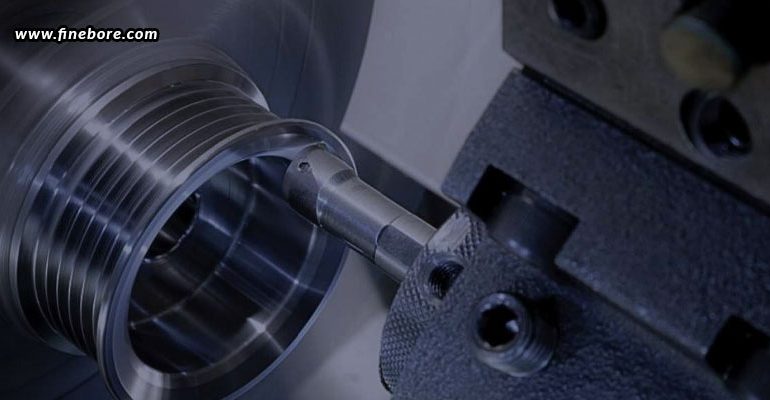
Precision boring is a demanding machining operation where even small deviations can affect bore accuracy, surface finish, tool life, and component performance. As manufacturers adopt tighter tolerances and higher production speeds, rotating tooling design becomes increasingly important. Among the factors influencing boring performance, balance and symmetry play a critical role. A boring tool rotates around the spindle axis while its cutting edge operates at an offset, creating dynamic forces that can cause vibration and instability if poorly controlled. Proper balance and symmetry help minimize unwanted forces, maintain stable cutting conditions, and deliver consistent bore quality, making them essential for high-precision rotating boring applications.
Why balance matters in rotating boring tools
When a boring tool rotates, its mass moves continuously around the spindle axis, making stability essential for consistent machining. Single-point boring tools are inherently challenging because the cutting edge is positioned away from the rotational centre, creating an uneven mass distribution. As spindle speed increases, even small amounts of imbalance can generate greater dynamic forces, potentially causing vibration, surface-finish problems, dimensional inaccuracies, and increased spindle loading. The underlying principle is centrifugal force: uneven mass distribution produces outward forces during rotation, and their effect becomes more pronounced at higher RPM. For precision boring, these forces can influence bore diameter, roundness, surface finish, and geometric accuracy. The appropriate balance level therefore depends on spindle speed, tool configuration, boring diameter, overhang, and component tolerances.
How symmetry contributes to rotational stability
Symmetry in boring-tool design is not simply about making the tool appear identical on both sides. It refers to the distribution of mass and geometry around the rotational axis. Because boring tools often position their cutting elements away from the centreline, maintaining favourable mass distribution can be challenging. Effective design must accommodate the required cutting position while controlling unwanted dynamic forces during rotation. The distance between the cutting system and rotational centre also influences stability, particularly as spindle speeds increase. Greater radial offset can amplify the effects of imbalance and affect cutting behaviour. Precision boring-tool design therefore considers the position of the boring bar, cutting edge, and other components relative to the centreline.
Balance, vibration, and bore accuracy
An unbalanced rotating boring tool can generate dynamic forces that repeat with every revolution, creating vibration within the tool assembly, spindle, and workpiece. Under certain conditions, these forces may interact with the natural frequencies of the machining system, contributing to chatter and unstable cutting. Such vibration can affect surface finish, dimensional consistency, roundness, tool life, cutting-edge stability, and overall process reliability. The effects can become particularly important when producing precision bores where even minor deviations can affect component performance. The cutting edge must follow a controlled circular path to produce accurate geometry. If vibration causes unpredictable movement, the finished bore may show dimensional variation, geometric inaccuracies, or visible vibration marks. Balance therefore contributes indirectly to bore accuracy by helping maintain a stable and predictable cutting path throughout the machining cycle.
Balance and tool design must work together
Balancing cannot compensate for poor tool geometry. It is only one element of overall boring-tool design, working alongside boring-head geometry, cutting-edge position, boring-bar rigidity, component connections, and adjustment mechanisms. A balanced tool with excessive overhang may still experience deflection, while a rigid tool with uneven mass distribution can generate vibration at higher speeds. The complete rotating assembly must therefore be considered rather than focusing only on the boring head. This assembly may include the machine spindle, toolholder, boring head, boring bar, insert holder, cutting insert, adaptors, and extensions. Each component contributes to the overall mass distribution and dynamic behaviour. Changing one component can alter the balance characteristics of the complete system. This is particularly relevant for modular boring systems, where different configurations can significantly influence rotational stability.
Why balance becomes more important at higher speeds
As spindle speed increases, the effects of tool imbalance become increasingly significant. A boring tool that operates smoothly at lower RPM may begin generating vibration when rotational speed rises because higher-speed machining places greater demands on the dynamic stability of the complete tooling system. Although increased spindle speed can improve productivity, these gains are valuable only when cutting conditions remain stable. Excessive vibration may force operators to reduce spindle speed or feed rate, limiting the productivity improvements that higher-speed machining was intended to deliver. A properly designed and appropriately balanced boring tool can help maintain stable cutting conditions at suitable operating speeds, supporting both productivity and bore quality. Addressing imbalance may also allow manufacturers to increase cutting speeds and feeds while maintaining dimensional accuracy and surface finish. Balance is therefore an important consideration when optimizing high-speed precision boring operations.
Balance, surface finish, and tool life
Surface finish is often one of the clearest indicators of cutting stability. When vibration occurs, the cutting edge can leave repetitive marks or irregularities on the bore surface, potentially affecting components used for bearings, seals, shafts, and precision mating applications. Properly balanced tooling supports smoother rotational behaviour and more stable cutting conditions, which can contribute to improved surface finish and consistent machining results. Vibration can also increase mechanical stress on the cutting tool and machine components. Unstable cutting may accelerate insert wear, damage cutting edges, and place additional loads on spindle bearings and other machine elements. Maintaining stable rotational behaviour can therefore support longer and more predictable tool life. Over extended production runs, this may reduce unnecessary tool changes, improve process consistency, and help manufacturers maintain reliable machining performance while controlling maintenance and tooling costs.
Designing boring tools for balance and symmetry
Effective balance begins during the design stage, when engineers consider how the boring head and its components behave during rotation. Important factors include mass distribution, cutting-edge position, component geometry, tool overhang, adjustment range, structural rigidity, connection accuracy, and intended operating speed. These factors become particularly important in adjustable boring heads because moving the cutting edge can change the tool’s mass distribution. Advanced boring-head designs may incorporate balancing mechanisms that compensate for changes in cutting-component positions, while other designs focus on maintaining a compact configuration and minimizing movement away from the rotational centreline. Both approaches demonstrate that balance cannot be separated from mechanical design. The geometry, adjustment system, rigidity, and configuration of the complete boring tool must work together. By considering these elements from the beginning, engineers can develop boring systems capable of delivering stable, predictable, and accurate performance.
Choosing rotating boring tools for precision applications
When selecting a rotating boring tool, manufacturers should consider more than its diameter range or adjustment capability. Factors such as spindle speed, bore diameter, tool overhang, workpiece material, tolerance requirements, and expected surface finish all influence tooling performance. For high-precision applications, particular attention should be given to rotational stability, balance characteristics, rigidity, runout, adjustment repeatability, tool configuration, and recommended operating conditions. A tool suited to slow-speed conventional boring may not deliver the same performance in high-speed precision machining. The tooling system should therefore match the complete machining requirement rather than simply meeting the bore’s dimensional specifications. FineTech Toolings, among leading precision boring head manufacturers in Bangalore, provides engineered solutions that support stable cutting, accurate bore production, improved surface finish, longer tool life, and reliable performance.
Balance and symmetry are fundamental to the performance of rotating boring tools. Because cutting elements often operate away from the spindle centreline, mass distribution directly influences dynamic behaviour. Poorly controlled imbalance can contribute to vibration, chatter, surface-finish problems, dimensional variation, and accelerated tool wear. Properly engineered balance and symmetry help maintain a stable cutting path and consistent machining performance. However, balance must work alongside rigidity, tool geometry, adjustment accuracy, runout, spindle condition, and the complete tool assembly. As manufacturing demands tighter tolerances, higher speeds, and greater automation, understanding these relationships becomes increasingly important. For manufacturers seeking predictable bore quality, balanced and well-engineered boring tools are an essential part of precision machining.