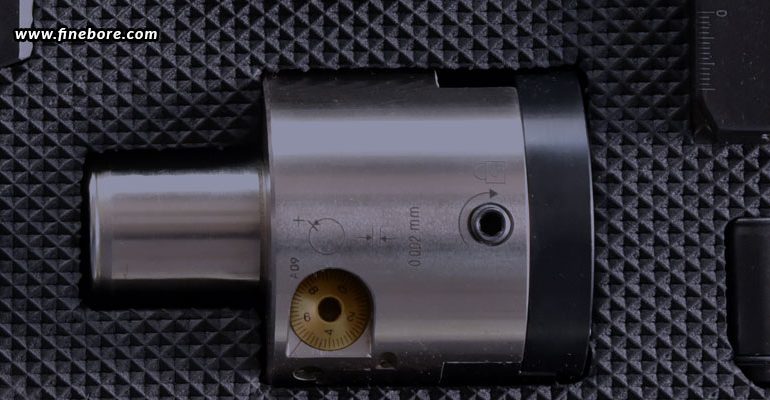
Precision machining is essential for creating components that require outstanding dimensional accuracy and surface finish. Although machining parameters and tool selections affect outcomes, the precision of a bore is often reliant on the fine adjustment mechanism of the boring head. These meticulously designed systems enable operators to make minute, controlled adjustments to the cutting diameter with remarkable repeatability. By integrating advanced mechanical design, precision manufacturing, and motion-control principles, fine adjustment mechanisms facilitate the attainment of the stringent tolerances necessary in contemporary high-precision machining applications.
Why adjustment accuracy matters in boring operations
Today’s manufacturing sectors encounter more rigorous quality standards than ever before. Components must perform reliably under challenging conditions while preserving precise dimensional relationships with adjacent parts. Consequently, bores frequently require tight tolerances, roundness, cylindricity, and concentricity. In numerous applications, acceptable variations can be measured in mere microns. Consistently achieving these specifications demands a level of control that surpasses what traditional machining methods can offer. Precision boring heads that feature fine adjustment mechanisms provide the necessary control to fulfill these exacting requirements.
Why small adjustments create big differences
A distinctive aspect of boring operations is that even the slightest tool movements can greatly influence the final bore size. The cutting edge is positioned radially from the centreline of the boring head, meaning any adjustment directly affects the diameter being machined. Since the bore diameter changes by twice the amount of radial movement, a seemingly insignificant adjustment can lead to a considerable impact on the final outcome. For instance, a radial adjustment of just 0.01 mm results in a 0.02 mm alteration in bore diameter. This relationship underscores the importance of precise control in achieving desired results. Without a reliable adjustment mechanism, achieving accurate dimensions would require excessive trial cuts, increased inspection, and longer setup times.
How fine adjustment mechanisms operate
Fine adjustment mechanisms are designed to accurately control the positions of boring head cutting tools, ensuring consistent machining performance.
- Transforming rotation into linear motion
At the heart of every fine adjustment mechanism lies the ability to convert rotational motion into precise linear movement. When an operator turns an adjustment screw or dial, the rotational input is conveyed through specially designed mechanical components that move the cutting insert carrier either inward or outward by a specific distance. This radial movement directly affects the boring diameter, allowing for accurate control over material removal and guaranteeing precise machining results.
- The importance of precision threads
Precision threads play a crucial role in fine adjustment mechanisms by transforming rotational motion into linear displacement. This capability enables operators to position the cutting edge with exceptional accuracy. The pitch of the threads dictates the distance moved per revolution, with finer pitches allowing for more precise adjustments. High-quality thread machining is vital for ensuring smooth operation and consistency, minimizing variation, and facilitating accurate, repeatable control in precision boring tasks.
- Micrometre-style adjustment systems
Micrometre-style adjustment systems improve both accuracy and user-friendliness in contemporary precision boring heads. They incorporate graduated scales and reference markings that empower operators to make confident, controlled diameter adjustments. Much like measuring instruments, these systems offer clear visual feedback, which helps to reduce setup errors. By minimizing trial-and-error adjustments, they decrease machine setup time and enhance productivity while ensuring high levels of machining precision and consistency in challenging manufacturing settings.
The engineering behind accurate and repeatable adjustments
Precision boring heads guarantee reliable and consistent adjustments through engineered dependability and predictable cutting-edge movement.
- Understanding backlash
A significant challenge in the design of adjustment mechanisms is backlash, which refers to the slight loss of motion that occurs when the direction of movement changes. Before the cutting edge can respond, any internal clearance must be addressed. Even a small amount of backlash can lead to uncertainty in positioning, complicating precise adjustments. In high-precision boring, this can impact dimensional accuracy, extend setup times, and result in inconsistencies in the final bore size, ultimately diminishing overall machining reliability.
- How manufacturers minimize backlash
To mitigate backlash and enhance positioning accuracy, manufacturers employ finely machined threads, optimized component interfaces, preloaded adjustment assemblies, and sturdy locking mechanisms. Strict manufacturing tolerances further reduce unwanted internal movement. Collectively, these engineering strategies ensure that adjustment inputs result in predictable cutting-edge movement. By minimizing mechanical play, operators can have increased confidence during setup and achieve more consistent dimensional control throughout machining operations.
- Why repeatability matters
Repeatability guarantees that the same tool position can be consistently attained over time, which is even more critical than mere adjustment accuracy. This is particularly vital in production settings where inserts are swapped, maintenance is conducted, or jobs are changed. A repeatable system enables quick restoration of previous settings with minimal trial cuts. Consequently, setup times are reduced, leading to a significant improvement in production efficiency.
The influence of fine adjustment on bore quality and surface finish
Fine adjustment mechanisms enhance dimensional precision, bore quality, and reliable performance in machining processes.
- Enhancing bore geometry
The impact of fine adjustment systems goes beyond mere diameter regulation. Precise positioning of the cutting edge is crucial for attaining the correct bore geometry, which includes roundness, straightness, and cylindricity. These geometric attributes are vital for components that necessitate accurate alignment and dependable mechanical performance. By enabling controlled and repeatable tool movement, fine adjustment mechanisms guarantee that the machining process upholds the high accuracy required for intricate engineering tasks.
- Advantages for surface finish
The surface finish is significantly affected by cutting stability and the precision of tool positioning. When a boring head is finely and accurately adjusted, it facilitates smoother cutting actions, stable chip formation, and minimized vibration during machining. These factors lead to a superior surface finish with fewer imperfections. Such finishes are particularly critical in components like bearing housings, hydraulic cylinders, and sealing surfaces, where performance relies on low friction, effective sealing, and consistent contact behaviour.
- Improved component fit and functionality
In the end, the goal of precision boring is to create components that fit together correctly and function reliably in operation. Accurate bore dimensions, coupled with high-quality surface finishes, ensure proper fit, decreased wear, and enhanced operational lifespan of mechanical systems. Fine adjustment mechanisms are essential in achieving these results by providing the necessary control to maintain consistent machining precision throughout production runs.
Choosing precision boring heads for modern manufacturing
When choosing a precision boring head, it is crucial for manufacturers to thoroughly assess the quality of the adjustment mechanism. Important factors to consider include adjustment resolution, repeatability, backlash management, user-friendliness, structural integrity, and long-term dependability. A superior system facilitates accurate and efficient adjustments, thereby reducing dimensional inaccuracies and enhancing machining consistency. Investing in high-end boring heads offers advantages that extend beyond mere accuracy, such as decreased scrap rates, lower rework expenses, quicker setups, enhanced productivity, improved process reliability, and uniform product quality. These benefits ultimately lead to a reduction in overall manufacturing costs and an improvement in operational performance. As tolerances become stricter and expectations rise, manufacturers increasingly rely on specialized tooling suppliers. FineTech Toolings, recognized as one of the leading , provides precision-engineered boring solutions tailored for tight tolerances, machining stability, repeatability, and consistent bore quality across various industrial applications.
Fine adjustment mechanisms rank among the most critical features of a precision boring head. By allowing for highly controlled radial movement of the cutting edge, these systems enable manufacturers to attain the accuracy, consistency, and repeatability essential for contemporary machining operations. Their effectiveness relies on a blend of precision threads, backlash management, structural rigidity, thermal stability, and sophisticated engineering design. Collectively, these components ensure that even the slightest adjustments yield reliable and predictable machining outcomes. As manufacturing standards continue to advance, the significance of fine adjustment technology will only grow. Gaining insight into the principles behind these mechanisms allows manufacturers to recognize how precise motion control directly influences bore quality, production efficiency, and overall machining success.