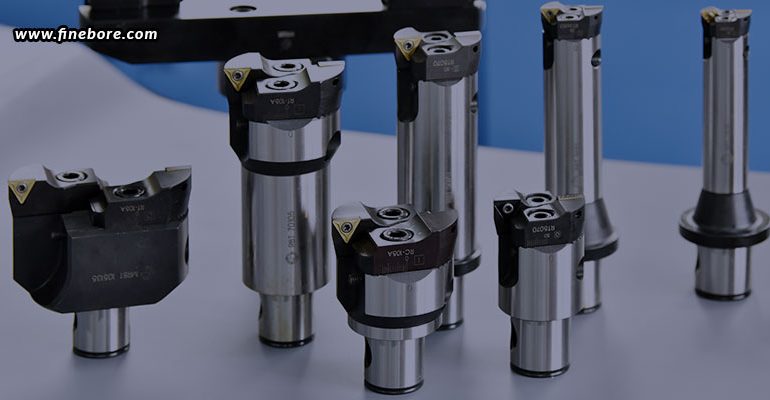
Precision machining is a field where multiple engineering decisions need to work together in harmony for the perfect outcome. One such decision is the choice of a boring head – a finely engineered system where rigidity, adjustability, balance, chip control, thermal stability, and more must coexist, with no compromise. A perfect boring head is defined by how effectively these elements are harmonized to deliver repeatable micron-level accuracy across different materials, machine platforms, and production environments. Precision in boring, after all, is the outcome of a complete system, and any flaw can undermine accuracy. This blog explores what makes for a perfect boring head, examining the key design priorities that need to be balanced, while also exploring the trade-offs that shape high-performing tooling.
Rigidity
Rigidity is the foundational requirement of a boring head, without which no amount of fine adjustment or digital control can prevent dimensional deviation. During cutting, radial and axial forces attempt to deflect the tool; even microscopic deflection alters the tool path, resulting in oversized or tapered bores, inconsistent surface finish, and loss of roundness. In fine boring operations, where tolerances are extremely tight, even minimal elastic deformation is unacceptable. To achieve the required rigidity, boring heads are engineered with compact geometries and short force paths that reduce bending moments, along with thick cross-sections around critical load-bearing areas, and precision-ground mating surfaces to eliminate micro-movement. Ultimately, a perfect boring head is one that strikes the right balance between rigidity and mass – remaining sufficiently stiff to maintain accuracy, without becoming excessively heavy.
Adjustability
Another defining characteristic of a boring head is its ability to adjust the cutting diameter with extreme precision. This precision is typically achieved through mechanical micro-adjustment systems that use fine-pitch screws to convert rotational motion into controlled radial movement. In recent years, modern boring heads have increasingly incorporated adaptive control integration with CNC machines, servo-driven systems for automatic diameter correction, and digital readouts to provide precise positional feedback. While digital systems significantly improve accuracy and repeatability, they must be carefully integrated so that electronics do not compromise rigidity or long-term reliability. In high-quality designs, robust locking systems are employed to ensure stability during cutting, and backlash is eliminated through preloaded adjustment mechanisms. However, the challenge lies in creating an adjustment mechanism that is both precise and robust, capable of maintaining position even under sustained cutting forces.
Balance
Even a perfectly rigid and adjustable boring head can fail if it isn’t properly balanced. As spindle speeds increase, centrifugal forces amplify even minor imbalances in the tool, leading to diminished surface finish quality, increased vibration and chatter, and accelerated spindle bearing wear. For this reason, maintaining balance is critical, and is achieved through symmetrical mass distribution, the use of adjustable counterweights or balancing rings, and precision balancing during manufacturing. Ultimately, a perfect boring head maintains stable balance across a wide range of diameters and cutting conditions, without requiring frequent rebalancing.
Chip control
Chip control can directly affect accuracy, surface finish, and tool life. When chip evacuation is poor, chips can accumulate in the cutting zone, leading to scoring or scratching of the bore surface, inconsistent cutting forces, and heat buildup near the cutting edge. Effective chip flow is thus a critical defining factor that can be achieved through polished internal surfaces to prevent chip adhesion, through-tool coolant delivery to flush chips efficiently, and optimized internal geometries that guide chips away from the cutting zone. Importantly, chip evacuation must remain reliable across a wide range of materials, from soft aluminum alloys to hardened steels.
Vibration damping and stability
Vibration control is essential for achieving fine surface finishes and maintaining dimensional accuracy. Any vibration arising from material inconsistencies, excessive tool overhang, or harmonic resonance between the tool and machine can compromise micron-level tolerances. To counter these issues, boring heads must be paired with vibration-absorbing materials or coatings, optimized cutting-edge geometries to reduce cutting forces, and damped boring bars containing internal masses or fluid-based systems. Ultimately, a perfect boring head works in harmony with damping solutions, rather than relying on them as a corrective measure.
Thermal stability
Thermal stability is another critical consideration, as heat generated during machining can cause minute dimensional changes that shift the cutting-edge position by several microns. Such thermal expansion, if uncontrolled, can directly affect bore size, roundness, and surface finish. A perfect boring head minimizes this risk with thermally stable materials, symmetrical designs that expand uniformly, and compatibility with efficient coolant delivery systems that manage heat at the cutting zone. Together, these measures ensure dimensional accuracy, even under prolonged machining cycles, high spindle speeds, and varying thermal loads encountered in demanding production environments.
Material engineering
Material engineering is just as important as the other facets of boring head design, as material selection directly influences rigidity, weight, vibration behavior, and long-term durability. High-performance boring heads typically use high-strength alloy steels to deliver structural integrity and excellent wear resistance, combined with hardened and stress-relieved materials that preserve dimensional stability under cutting loads. Advanced surface coatings are applied to reduce friction, minimize wear, and prevent corrosion; while damping materials or composite elements may be integrated to absorb vibration, enabling higher stability without sacrificing stiffness or increasing overall mass.
User-centric design
User-centric design is essential in precision tooling, as a boring head that is difficult to adjust, set, or maintain inevitably introduces human error and reduces process consistency. Effective designs prioritize clarity and simplicity through clearly marked adjustment scales or digital displays, intuitive locking mechanisms, and minimal setup time. A well-designed boring head maintains its performance through wear-resistant components, sealed adjustment mechanisms that protect against contamination, and provisions for easy calibration and servicing, ensuring long service life and reliable repeatability on the shop floor.
Designing a boring head is ultimately an engineer’s balancing act, where increased rigidity, adjustability, and damping must be carefully weighed against weight, complexity, and responsiveness. What differentiates an average tool from an exceptional one is how well these competing priorities are balanced. In a high-performing boring tool, rigidity ensures dimensional stability, adjustability delivers micron-level control, balance suppresses vibration, and effective chip evacuation preserves surface quality. This approach is exemplified by FineTech Toolings, leading boring head manufacturers in India, whose designs combine thoughtful material selection, thermal stability, and user-centric design to deliver consistent, repeatable precision. In modern machining, where tolerances tighten and expectations rise, the boring head remains a quiet, but critical contributor to manufacturing excellence, proving that true precision is achieved not by extremes, but by balance.