
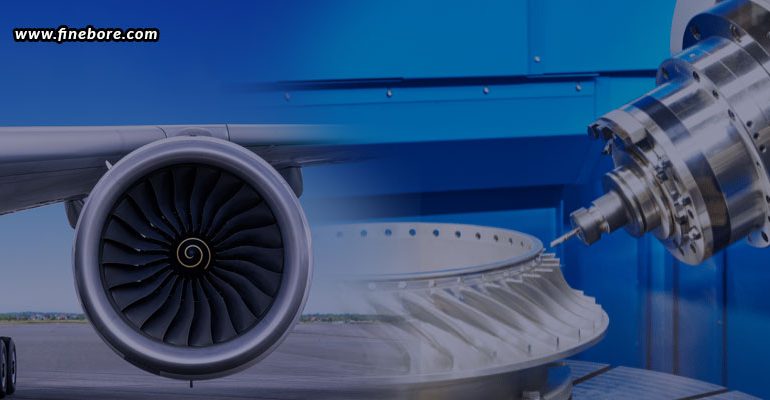
Modern aerospace manufacturing represents one of the most challenging settings for precision machining. Components for aircraft and spacecraft are required to adhere to extremely stringent tolerances, endure severe operating conditions, and preserve structural integrity throughout extended service durations. Numerous essential parts depend on accurately machined internal bores for proper alignment, load distribution, and fluid movement. Central to this operation is the boring bar. Traditionally employed to enlarge and finish pre-drilled holes, boring bars in aerospace machining must accommodate thermal expansion in titanium, manage chatter during deep internal cuts, and modify their geometry for advanced composite materials, thereby ensuring the precision, reliability, and safety demanded in contemporary aerospace production.
Why aerospace machining is so demanding
Aerospace components are required to function in conditions where temperature, pressure, and mechanical loads vary significantly. For instance:
- Jet engines can reach temperatures above 1,000°C.
- Aircraft structures face repeated cycles of stress.
- Components need to be lightweight yet strong.
To meet these requirements, aerospace manufacturers depend on advanced materials, particularly titanium alloys nickel-based superalloys, carbon fibre reinforced polymers, and hybrid composite-metal structures. While these materials enhance performance, they also pose considerable machining challenges, particularly during internal boring operations.
Boring, unlike external machining, takes place within the component, which restricts visibility, chip removal, and heat dissipation. Consequently, the design of tools, stability, and process control become essential considerations.
Challenges in aerospace boring operations
- Excessive heat generation from Titanium
Titanium alloys are commonly utilized in the aerospace sector due to their excellent strength-to-weight ratio and their ability to withstand corrosion and high temperatures. Nonetheless, machining titanium presents difficulties because of its poor heat conductivity. Rather than dissipating heat away from the cutting zone, the heat accumulates at the cutting edge. This situation can lead to various issues during boring operations, such as rapid wear of tools, decreased tool lifespan, inferior surface finish, and inaccuracies in dimensions. As boring takes place within a hole, the challenge of heat removal is exacerbated.
- Chatter and vibration in deep bores
Another significant challenge in aerospace boring is chatter, which refers to the undesirable vibrations occurring between the tool and the workpiece. Boring bars frequently function with extended overhangs within deep holes. The greater the extension of the tool from the machine holder, the more flexible it becomes. This increased flexibility heightens the likelihood of vibration. Chatter can result in rough surface finishes, dimensional inaccuracies, early tool failure, and rejected parts. In aerospace manufacturing, where precision is paramount, even minor vibrations can compromise the quality of components.
- Composite materials present cutting challenges
Modern aircraft are increasingly utilizing composite materials like carbon fibre reinforced polymers (CFRP) to achieve weight reduction and enhance fuel efficiency. Although composites are both strong and lightweight, their behaviour during machining is markedly different from that of metals. Some prevalent challenges include delamination, fibre pull-out, abrasive wear, and heat damage that can compromise the integrity of the resin matrix. These factors render internal boring operations especially challenging when dealing with composite components.
How modern boring bars overcome these challenges
- Heat management for titanium machining
Modern boring bars employ various techniques to manage the significant heat produced during titanium machining. Cutting-edge carbide inserts featuring heat-resistant coatings like TiAlN or AlTiN are utilized to sustain cutting efficiency at elevated temperatures. Numerous tools are also equipped with through-tool coolant channels that supply high-pressure coolant directly to the cutting edge, effectively dissipating heat and removing chips. Furthermore, optimized cutting parameters, such as moderate cutting speeds and consistent feed rates, contribute to minimizing heat accumulation and preserving dimensional accuracy.
- Vibration-damped tool design
Deep boring tasks frequently involve extended tool overhangs, which can lead to vibration and chatter during the machining process. To counter this, contemporary boring bars are engineered with internal damping systems that absorb and dissipate vibrational energy. This stabilization enables machinists to uphold precision even when the tool is deeply inserted into a component. Utilizing larger-diameter boring bars, adhering to appropriate length-to-diameter ratios, and ensuring secure connections with tool holders further enhance rigidity and facilitate smoother surface finishes.
- Specialized geometry for composite materials
Composite materials necessitate unique cutting tool geometry due to their significantly different structure compared to metals. Contemporary boring bars frequently utilize polycrystalline diamond (PCD) inserts, which offer outstanding wear resistance when working with abrasive carbon fibres. Extremely sharp cutting edges are essential for cleanly slicing through fibres instead of pulling them from the matrix. Additionally, optimized rake angles help to minimize cutting forces, which aids in preventing delamination between layers and ensures that the composite component retains its structural integrity.
- Flexible tooling for hybrid structures
Numerous aerospace components incorporate various materials, such as titanium mounting points combined with carbon fibre composite sections. Machining these hybrid structures demands tooling that can adjust to varying cutting conditions during the same operation. Modern boring systems enable operators to modify insert materials, cutting geometry, and machining parameters like feed rates and speeds. This adaptability facilitates stable machining performance across diverse materials while preserving the precision necessary for intricate aerospace components.
Aerospace machining imposes exceptionally high requirements on cutting tools because of the use of advanced materials such as titanium and carbon fibre composites. Although these materials improve aircraft performance, they also introduce challenges such as heat concentration, vibration during deep boring, and intricate cutting behaviour. Modern boring bars tackle these challenges with advanced insert coatings, vibration-damping designs, optimized cutting geometries, and effective coolant delivery systems. These advancements contribute to maintaining accuracy, surface finish, and tool longevity during machining. As aerospace technology progresses, the importance of precision tooling continues to grow. Companies like FineTech Toolings, recognized as reliable precision boring bars manufacturers in Bangalore, offer robust and precision-engineered solutions for the demanding requirements of aerospace machining applications.