Most machinists typically consider metals like steel, cast iron, aluminium, and alloys when thinking about boring bars. For many years, these materials have set boundaries. However, contemporary industries are venturing into new territories where non-metallic materials are becoming increasingly significant. Plastics, ceramics, and advanced synthetic materials are now vital components in aerospace, medical devices, electronics, and automotive industries. But, when we move to such non-metallic materials, factors like cutting geometries, material compatibility, vibration management, and tool longevity all undergo changes. Let’s delve into the evolution of boring bars designed to work with non-metallic materials, and discuss the implications for machinists, manufacturers, and industries that are challenging the boundaries of precision.
Boring bars for plastics
- The challenge
While plastics may appear softer than metals, they present their own set of unique challenges during machining. High cutting temperatures can easily cause the material to soften, warp, or even melt. Instead of shearing cleanly, edges often fray or deform, resulting in burrs that compromise the final finish. Furthermore, plastics are susceptible to dimensional instability, expanding or contracting more significantly than metals when subjected to heat, which complicates precision control.
- Tool design for plastics
To tackle these issues, boring bars specifically designed for plastics are meticulously optimized. They are equipped with sharp cutting edges that shear cleanly without tearing, and polished rake faces that minimize friction and prevent chip adhesion. High rake angles are utilized to reduce cutting force and heat generation, while carbide or PCD inserts are frequently employed to guarantee both durability and consistently clean cutting performance.
- Coolant and chip control
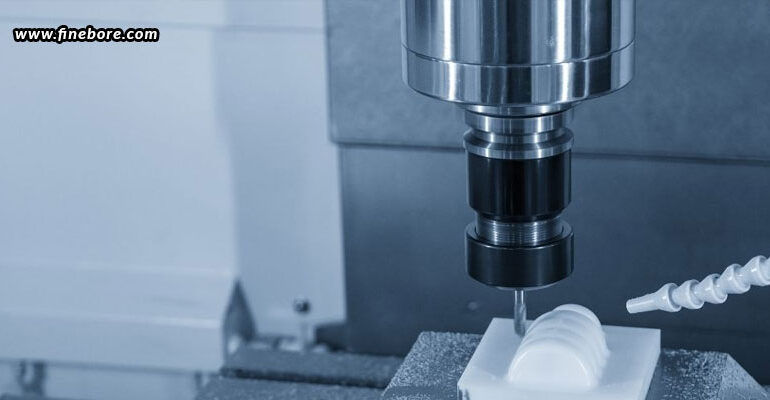
In the machining of plastics, the coolant strategy is as crucial as the tool geometry. Rather than using traditional flood coolant, compressed air or mist cooling is typically favoured, as it helps to prevent the workpiece from absorbing moisture and swelling. Chip breakers are also precisely designed to manage the long, stringy swarf that plastics often generate, preventing chips from wrapping around the tool and disrupting the machining process.
- Applications
Plastics find applications across a variety of industries where boring operations are essential. In the medical field, biocompatible plastics such as PEEK are machined for surgical instruments and implants. In the automotive sector, lightweight polymer components are bored with high precision to fulfil performance standards. Even in consumer products, ranging from electronic housings to robust casings, plastics necessitate boring solutions that provide both dimensional accuracy and a smooth surface finish.
Boring bars for ceramics
- The challenge
Ceramics are positioned at the far end of the spectrum when compared to plastics. They possess extreme hardness, are brittle, and lack flexibility, which makes machining them particularly challenging. Their significant hardness leads to rapid tool wear if inappropriate inserts are utilized, while their brittle characteristics result in fracturing instead of deformation, necessitating careful and precise cutting conditions. Additionally, the machining of ceramics produces fine abrasive dust that not only presents safety hazards but can also inflict damage on machines and tools if not adequately controlled.
- Tool design for ceramics
To address these challenges, boring bars specifically designed for ceramics incorporate unique features. Inserts crafted from PCBN (Polycrystalline Cubic Boron Nitride) or diamond are favoured due to their capacity to endure extreme hardness. Negative rake angles are frequently utilized to absorb the substantial cutting forces and avert early chipping. Tool holders need to be exceptionally rigid to reduce vibration, as even slight chatter can result in cracks in the workpiece. In certain configurations, through-tool coolant systems are implemented to control dust and lessen thermal shock.
- Techniques for success
Successful ceramic machining is heavily dependent on meticulous control of feeds and speeds. Machinists typically employ shallow depths of cut to alleviate stress on both the tool and the workpiece. In more advanced applications, ultrasonic-assisted boring is being adopted, where high-frequency vibrations diminish cutting forces and enhance stability. These methods enable the achievement of precise results even with such difficult materials.
- Applications
Ceramics are becoming increasingly vital in industries that require outstanding durability and heat resistance. In the aerospace sector, they are utilized for engine components that must endure extreme temperatures. In the medical field, bio-ceramics are machined into dental implants and orthopaedic devices. Electronics manufacturers depend on ceramics for substrates and insulators, where bores must be accurate to the micron to guarantee performance and reliability.
Beyond plastics and ceramics
- Graphite and carbon-based materials
Graphite is extensively utilized in various applications, including EDM electrodes, fuel cells, and moulds designed for high temperatures. Although it is easier to cut than metals, its abrasive characteristics can quickly wear down tools. To mitigate this issue, boring bars fitted with diamond-coated inserts are often favoured, as they enhance tool longevity and ensure precision. Another significant challenge in graphite machining is the generation of dust, necessitating efficient extraction systems to safeguard both the machinery and the operator.
- Advanced polymers and hybrids
High-performance polymers that are reinforced with fibres or fillers offer increased strength and durability; however, they can exhibit unpredictable behaviour during machining. For example, fibre-reinforced plastics may lead to rapid tool wear if the cutting edges are not appropriately matched to the material. To produce clean and precise bores, boring bars must strike a balance between sharpness and durability, often requiring specialized inserts and cutting geometries. These materials are becoming more prevalent in industries where both strength and lightweight characteristics are crucial.
- Glass and quartz
Glass and quartz rank among the most brittle materials faced in machining, yet they play a vital role in optics, semiconductors, and high-precision electronics. Machining these materials necessitates the use of diamond-tipped boring bars, along with machines that can maintain outstanding stability. The emphasis is placed not only on precision but also on achieving flawless surface finishes devoid of micro-cracks, as even the tiniest flaws can undermine performance in sensitive applications.
Boring bars are no longer confined to metals. The machining of plastics, ceramics, graphite, and other non-metallic materials has presented new challenges, and has inspired tool innovations that redefine possibilities. From sharp-edged carbide tools designed for plastics to diamond-coated inserts for ceramics, boring bar technology is evolving to meet the needs of industries that require lighter, stronger, and more specialized components. For machinists, this necessitates a re-evaluation of techniques, tool choices, and process planning. For various industries, it opens up new design opportunities in aerospace, medical, electronics, and more. Manufacturers looking for dependable tooling solutions can turn to Finetech Toolings, a trusted name for boring bars in Bangalore, known for delivering precision, durability, and efficiency across diverse machining applications. The message is unmistakable – the future of boring is not solely metallic, it encompasses multiple materials.